What is hollow core fiber? Hollow-core optical fiber, also referred to as “hollow optical fiber ” in many articles on the Internet, is called Hollow-core fiber (HCF) in English and is a new type of optical fiber.
Why Is Hollow-Core Optical Fiber So Popular
The reason for studying hollow-core optical fibers is not that reducing the size of the core inside can reduce costs. This is because optical signals have more advantages when propagating in the air than glass fibers.
The Development and Evolution of hollow-core Optical Fiber


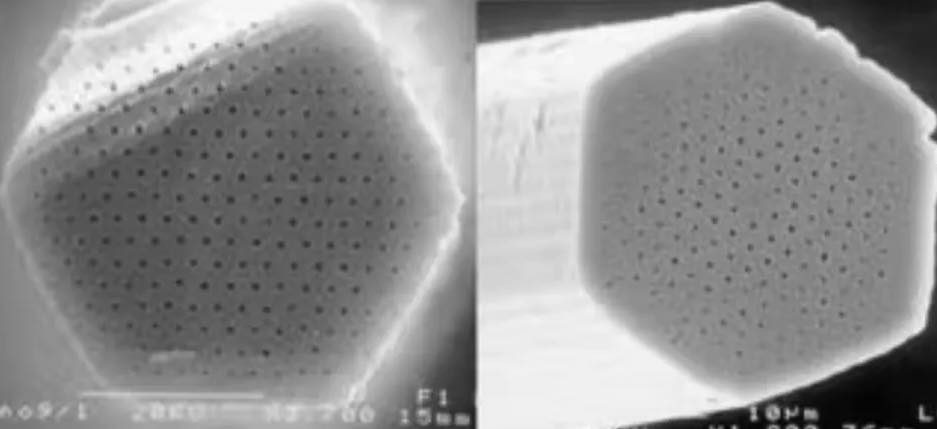
Cross-section of hollow-core photonic crystal fibers with different structural designs


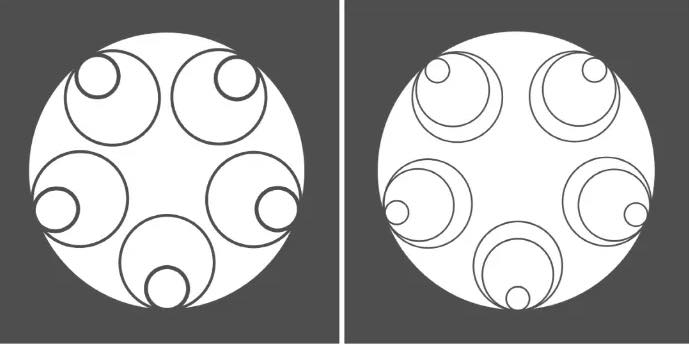
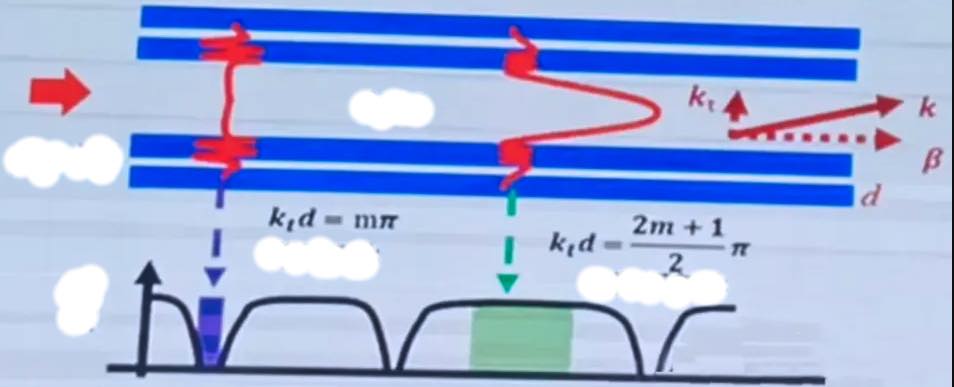
The purpose of nesting is related to “resonance.”
Photonic bandgap hollow core fiber vs. nested antiresonant nodeless fiber
Advantages of Hollow-core Fiber
- Lower latency. This has been introduced in detail before.
- Lower loss in transmission. The transmission loss of hollow-core optical fiber is also an important technical indicator of optical fiber. The lower the optical fiber loss, the longer the distance the optical signal can be transmitted in the optical fiber, and the easier it is for the signal to be identified and demodulated at the other end. When optical signals are transmitted in the air, the loss is less than when they are transmitted in quartz glass. As mentioned earlier, the current hollow-core optical fiber can achieve a loss of 0.174dB/km, which is on par with the performance of the latest generation of glass-core optical fiber. According to research institutions, the theoretical minimum loss limit of hollow-core optical fiber can be as low as 0.1dB/km, which is smaller than that of ordinary glass-core optical fiber ( 0.14dB/km ).
- Support more optical bands. Hollow-core optical fiber is not picky about light and can easily support multiple bands of light, such as O, S, E, C, L, and U.
- Reduced nonlinear effects. The nonlinear effect of hollow-core optical fiber is 3 to 4 orders of magnitude lower than that of conventional glass-core optical fiber, which allows the input optical power to be greatly increased, thereby increasing the transmission distance.
- Capable of transmitting high-power laser. When traditional glass-core optical fibers transmit high-power lasers, they absorb laser energy, causing heat accumulation at material defects or uneven temperature distribution between the core and cladding, causing optical fiber damage. In the case of hollow-core optical fiber, more than 99% of the optical power is transmitted in the air, and the light field and material weight are extremely small. Therefore, there is lower material absorption at the same transmission power, and it has a higher laser damage threshold. Simply put, high-power lasers do not easily burn it (kilowatt level). In addition to the advantages listed above, hollow-core optical fiber has low dispersion, thermal sensitivity, radiation resistance, etc. This is why the industry pays close attention to developing hollow-core optical fiber technology.
Application Scenarios of Hollow-Core Optical Fiber
- The first scenario is, of course, communication. The low loss and low latency of hollow core optical fibers are very suitable for optical fiber communications, especially the latency-sensitive communication scenarios mentioned above.
- The second scenario is sensing, which uses optical fiber for environmental perception. Hollow-core optical fiber has greater flexibility and large aperture characteristics. It can be used in optical sensing to measure temperature, pressure, flow, and chemical composition.
- The third scenario is laser application. As I just said, hollow-core optical fiber can withstand high-power lasers. Therefore, it can transmit laser beams, such as laser cutting and etching, in industrial manufacturing and deep in the human body to improve the imaging and treatment of diseased tissues. Transmitting lasers is a form of transmitting energy that has many potential applications.
Final words
To accelerate the implementation of this technology, we also need to pay attention to the following points:
- Standardization of the internal structure of optical fiber, what kind of architecture should be adopted for finalization and large-scale production.
- How can we improve the process, reduce manufacturing difficulty, and achieve mass production with a high pass rate?
- Verify and prepare solutions for engineering problems encountered in the current network deployment. The simplest one is how to weld if the hollow core fiber is broken.
- How to accelerate the industrial chain layout and provide supporting support regarding materials, devices, etc.
Please I want to call sade, give me her contact. I need Samsu oil to buy I’m in Ghana