I believe everyone is familiar with these numbers—the police(110. 911, 999), fire, ambulance, and traffic accident emergency(112) telephone numbers in my country. When we face emergencies and our lives are at risk, we can dial these numbers to quickly receive assistance from public security, fire, medical, and other emergency departments. This topic will discuss emergency visual alarm communication technologies worldwide.
These numbers are lifelines, but have you ever wondered what communication technology powers them? How is calling these emergency numbers different from dialing a regular phone number?
In today’s article, we will provide an in-depth explanation of the technical principles behind emergency calls.
Visual Alarm Communication Technologies Worldwide: What Makes Emergency Special Services Unique?

We often refer to 110, 119, 120, and 122 as emergency call numbers, but in the telecommunications industry, their official term is “emergency special service”.
There is a significant difference between emergency special services and regular telephone services.
When a user dials a phone number, the operator’s network equipment analyzes it. For regular numbers, the system goes through a complex and multi-step number analysis process, checking if the number belongs to:
- A mobile or landline network
- A local or foreign service
- A different network operator
- An international destination
However, when dialing an emergency special service number, the system bypasses these steps and immediately connects the caller to the local emergency call center (such as the 911 emergency dispatch center).
Emergency Calls: Free, Unrestricted, and Always Available
Calling an emergency service number is free and independent of the mobile phone’s current status. You can make an emergency call even if:
- Your phone is switched off
- You are in international roaming mode, even without roaming permission enabled
- Your phone does not have a SIM card
(Note: Please do not attempt this unnecessarily. Falsely calling emergency services is illegal.)
In contrast, regular phone calls require strict authentication. The communication system must:
- Verify the user’s identity
- Confirm the legitimacy of the number
- Check if calling permissions are active
- Ensure there is sufficient balance for the call
The system bypasses these steps with emergency special services to establish a connection quickly. This saves critical time, lowers barriers for users in distress, and ultimately reduces loss of life and property.
The Technical Evolution of Emergency Special Services
At its core, an exceptional emergency service is a telephone service. It relied on PSTN (Public Switched Telephone Network) technology in its early days.
With the rise of mobile communications, the 2G era introduced networks centered on circuit-switched (CS) domains, primarily supporting voice calls and SMS.
By the 3G era, the demand for mobile internet exploded, shifting networks toward full IP and packet-switched communication. This transition led to data services becoming the dominant mode of communication. Technologies such as:
- WCDMA, CDMA2000, and TD-SCDMA (3G era)
- FDD/TDD LTE (4G era)
- 5G NR (5G era)
all operate on packet-switched (PS) networks, primarily designed for data services.
Despite the shift toward internet-based communication, voice calls remain essential and cannot be eliminated. A new technical standard was developed to support multimedia services like voice calls over packet-switched networks—IMS (IP Multimedia Subsystem).
IMS, or IP Multimedia Subsystem, was first introduced in 3GPP R5 (2002) to provide multimedia services for 3G users. Over time, as the technical standards matured during the 4G era, IMS gained recognition from major operators and became widely adopted across the globe.
For students working in the communications industry, IMS is a well-known concept. Services like VoLTE in the 4G era, as well as VoNR, 5G messaging, and new 5G call features, all rely on IMS. Built on an IP bearer and using the SIP protocol at its core, IMS seamlessly integrates with 4G/5G data service networks to support a range of business applications.
As voice services transitioned into the IMS era, emergency services also saw significant changes.
While the basic process of dialing, answering, and speaking remains the same, the IMS technology behind the scenes makes these processes faster, safer, more reliable, and more efficient.
The First Major Improvement is in the Network’s Ability to Prioritize Emergency Services.
The IMS network prioritizes emergency calls, especially during periods of congestion. The system identifies these calls and places them in the highest-priority queue, allowing them to go through first. Regular calls, on the other hand, are temporarily placed in a “waiting” queue.
In addition to priority connections, IMS creates a “dedicated bearer” for emergency services, ensuring a certain level of Quality of Service (QoS) guarantee. This is similar to an “emergency lane” on a highway, ensuring that emergency calls have better clarity and stability and fewer disruptions, such as disconnections or noise.
IMS also streamlines the emergency service process. Traditional telephone calls may involve multiple network nodes, each handling specific signaling interactions. The IMS network simplifies this process for emergency calls, reducing the number of interactions. For example, when dialing an emergency number, there are no ringback tones or unnecessary delays. This results in faster connections and minimizes the risk of errors.
Secondly, the Business Carrying Capacity is Enhanced.
The traditional CS (Circuit-Switched) domain structure is rigid. Its limited capacity leads to severe traffic overflow, poor concurrency, and the inability to route and switch calls intelligently. Additionally, it has a low connection rate and inadequate emergency support and repair capabilities.
In contrast, the IMS network architecture is built on advanced packet-switching technology, offering high flexibility and scalability. This architecture effectively addresses the issues in traditional systems, significantly improving the system’s ability to handle business operations and considerably enhancing overall capacity.
Third, Comprehensive Expansion of Functions.
Traditional emergency services mainly relied on voice calls. When a call was connected, the user would describe the situation and location to the call center staff, who would then contact emergency responders to assist. This voice-based communication method, while functional, is limited in the amount of information it can convey.
IMS is a multimedia service platform that supports image, audio, and video services. This allows users to make video calls to report incidents or send photos, videos, and location information during a call. This enables emergency staff to understand the situation better and also aids in gathering critical evidence quickly, enhancing the efficiency and effectiveness of emergency responses.
In recent years, new reporting methods have gained attention, including SMS and app-based alarms.
SMS Alarm involves sending a text message to a special number, such as 12110, to report an emergency. This method is particularly beneficial for individuals with hearing or speech impairments, as well as for situations where someone needs to report a crime discreetly, such as theft on a bus or at home.
App Alarm has become increasingly popular in recent years. In the event of an emergency, users can open the relevant app and press the “one-click rescue” button to send an alarm message to the emergency services. Users must first download or open the app, then capture audio, video, and photos of the scene, which can be uploaded through the app to establish communication with emergency responders. This method allows for more detailed and immediate reporting of incidents.

Compared to the two methods mentioned earlier, the emergency call service based on the IMS network offers significant advantages in terms of functionality, ease of use, and reliability.
IMS adheres to the 3GPP protocol standard and is a native communication technology. It operates directly on mobile phones’ built-in systems, meaning users don’t need to install any additional apps, making it easier to promote and widely adopt.
In contrast, app alarms are developed separately across different regions and lack unified standards and interfaces. This creates challenges in integration and coordination between systems and results in low efficiency in digital governance.
SMS and app alarms also require constructing and developing corresponding platforms, which can be expensive. In high-concurrency situations, these platforms may struggle to provide adequate emergency support. As a next-generation communication technology, IMS is well-suited for unified development, offering powerful network processing capabilities that reduce costs and efficiently handle large numbers of concurrent users.
Comparison of Emergency Service Deployment Methods
Let’s explore the deployment of emergency special service systems.
Emergency special services use communication network technology to establish a reliable connection between users and relevant department call centers. In recent years, advancements in network technology—particularly introducing capabilities like 5G video—have led to several representative deployment methods, such as the operator CTI number allocation method, the converged communication product method, and the IMS privatized deployment method.
CTI Number Allocation Method of Operators
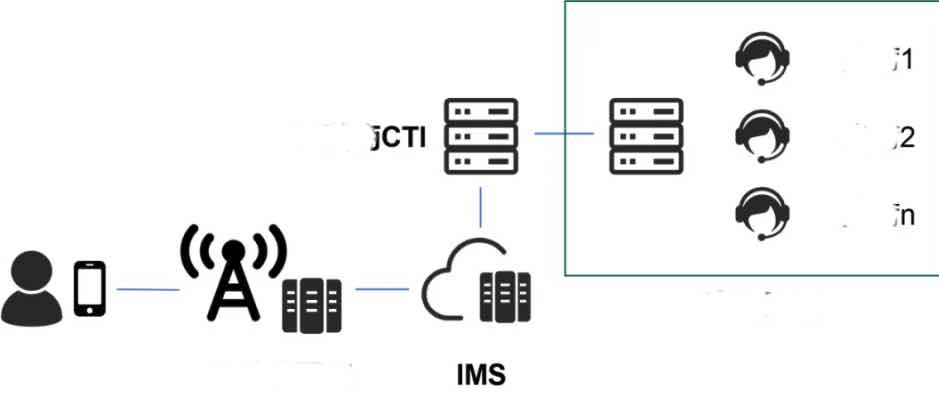
CTI (Computer Telecommunication Integration) refers to a call center solution provided by operators to address users’ business needs. This method integrates telecommunication services with computer systems to enhance call center operations.
The operator’s CTI system solution is highly complex, involving multiple components such as CTI servers, IVR (Interactive Voice Response) systems, automatic fax servers, and outbound servers. These elements require coordination across various technology manufacturers and standards, leading to a system that is challenging to build and maintain. Additionally, the cost of developing such a system is high. The complexity also challenges performance and stability, affecting the system’s efficiency.
Furthermore, this intricate system structure struggles to integrate with the operator’s IMS core system for video service interoperability and media negotiation control. The CTI solution also faces several other issues, including:
- Difficulty in coordinating interoperability between operators’ network gateways.
- Potential obstacles in developing 5G new call capabilities.
- Inability to privatize the call platform.
- Difficulty in integrating with specialized systems.
- Challenges in leveraging the data value of the platform.
Fusion Communication Method
Converged communications is another deployment method based on the IMS network.
In this model, customer service agents must manage two different answering modes, complicating operations. The standards for converged communication products are not unified, and these products are seen as transitional solutions. They face challenges integrating and coordinating multiple systems, and their scalability for IMS DC applications is limited. This method struggles to access various scenarios, networks, and devices. Additionally, converged communications systems cannot bypass IMS standards and core technology patents, limiting flexibility and long-term viability.
Private Deployment Based on IMS
Finally, the IMS-based private deployment emerges as a comprehensive solution that addresses all these challenges and is becoming the preferred method for deploying call center services.
A good example of this approach is 5G Visual Alarm Solution Based on IMS”. Hongtian Technology has been focused on the industrial application and development of IMS technology for over a decade. The company has created a complete product ecosystem that includes the IMS core system, network security, IMS edge computing, and SDK, offering full localization support and competitive advantages.
Their visualization solutions have been successfully implemented in alarm platforms such as 911/110/119/120/122 nationwide, and have been applied in the 12345 government hotline service. This model demonstrates how IMS-based privatization can effectively meet the requirements of modern emergency service systems, providing a scalable, reliable, and efficient solution for call center services.
Hongtian’s 5G Visualization Solution offers a privatized deployment approach, allowing related equipment and systems to be implemented on user-side platforms like the government cloud. The solution establishes secure interconnections with the operator’s core network through an IMS physically isolated multimedia relay gateway, addressing the issues of limited concurrency and the business expansion constraints faced by existing call system solutions. This setup boasts the advantages of standardization, unification, media negotiation, and open media control interfaces, making it a robust and scalable option for modern communication systems.
This solution effectively addresses the drawbacks of the operator’s CTI number allocation method and the traditional converged communication method. It features weak code integrated development, intelligent expansion, and easy operation and maintenance, offering a seamless experience for business deployment and ongoing support.
Moreover, the solution enhances security and reliability through its IMS system active-standby soft switching architecture and remote disaster recovery private deployment, ensuring robust backup and continuity for critical services. This makes Hongtian’s 5G visualization solution a comprehensive and efficient for emergency service and call center deployment.
The “5G Visual Alarm Receiving Solution based on IMS” offers several key advancements, particularly in exclusive channels and diverse alarm methods. One of the most exciting future capabilities is no-signal emergency telephone alarms. In the event of a disaster, as long as at least one operator’s base station is functioning, this solution will enable the sending of a 110 voice alarm even without a signal.
The solution will also enable resource coordination, command, monitoring, and alarm linkage, by connecting with public security command and monitoring networks. This will contribute to achieving goals in three-dimensional public safety networks, such as police helmets, law enforcement recorders, and intercoms, facilitating real-time monitoring, dispatch, and management of public security personnel and vehicles.
In conclusion, Hongtian’s IMS private deployment solution offers distinct advantages compared to the operator’s IMS public network solution. This solution delivers a lightweight version tailored to user needs, supports data privatization, reduces construction and maintenance costs, and enables integrated development.
With the IMS private deployment in place, emergency telephone numbers like 110, 119, 120, and 122 will become more powerful, improving the overall efficiency of emergency incident handling by relevant authorities. This transformation plays a key role in the digitalization of emergency management systems, optimizing resource allocation for manpower, vehicles, and other assets, and contributing to better monitoring, prediction, and management of emergencies. It will lead to greater safety for people’s lives and property, fostering a more secure and harmonious society.
Final Thoughts:
The rise and adoption of IMS is an inevitable trend in the advancement of communication technology. Its integration with AI will effectively address issues like data silos and inefficient inter-departmental collaboration, enhancing intelligent service capabilities and expanding the scope of new communication features. These innovations are not only reshaping traditional communication networks but also providing users with an entirely new communication experience.
We look forward to more breakthroughs in the communications field that will continue to improve people’s lives and bring us closer to a truly intelligent era.
Leave a Reply