How Can AI Be Categorized?
- Decision-making AI: Focuses on analyzing situations and making decisions. It helps users or systems choose the best course of action by evaluating multiple options and possible outcomes.

- Generative AI: Focuses on creating new content. Based on learned data, it can automatically generate text, images, music, and other content.
The past and present of generative AI
1. Early budding stage
- In 1950, Alan Turing proposed the famous “Turing Test,” which was a milestone in the field of generative AI and foreshadowed the possibility of AI content generation.
- In 1957, Lejaren Hiller and Leonard Isaacson completed the first musical work in history completely composed by computer, “Illiac Suite.“
- Between 1964 and 1966, Joseph Weizenbaum developed the world’s first conversational robot, “Eliza,” which completed interactive tasks through keyword scanning and reorganization.
- In the 1980s, IBM created the voice-controlled typewriter “Tangora” based on the invisible Markov chain model.

2. Sedimentation and Accumulation Stage
- In 2007, Ross Goodwin, an artificial intelligence researcher at New York University, created an artificial intelligence system that wrote the novel “1 The Road,” the world’s first novel created entirely by artificial intelligence.
- In 2012, Microsoft publicly demonstrated a fully automatic simultaneous interpretation system that can automatically generate Chinese speech from the content of English speakers through speech recognition, language translation, speech synthesis, and other technologies.

3. Rapid Development Stage
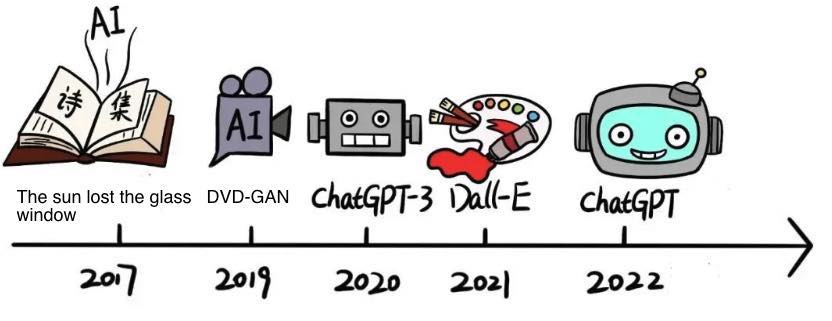
- In 2017, Microsoft launched the world’s first poetry collection, “The Sun Lost the Glass Window,” which was 100% created by artificial intelligence.
- In 2019, the Google DeepMind team released the DVD-GAN architecture for generating continuous videos.
- In 2020, OpenAI released ChatGPT3, marking an important milestone in the fields of natural language processing (NLP) and AIGC.
- In 2021, OpenAI launched DALL-E, which is mainly used for interactive content generation between text and images.
- Since 2022, OpenAI has released the new ChatGPT model many times, setting off another climax of AIGC. It can understand and generate natural language and have complex conversations with humans.
Understanding Generative AI: What Are The Principles?
But how Does AI Learn And Generate Knowledge?
1. Clay Figurines: Building The Hardware Architecture
Computing power — the skeleton of a clay figurine
- GPU (Graphics Processing Unit): This type of computer provides powerful parallel computing capabilities. Thousands of small processing units work in parallel, greatly improving computing efficiency.
- TPU (Tensor Processing Unit): Hardware specifically designed to accelerate AI learning, which can significantly speed up calculations and further enhance the framework’s strength.
The power of preservation: the blood of clay figures
- Large-capacity RAM: Many intermediate calculation results and model parameters must be stored in memory when training generative AI models. Large-capacity RAM can significantly improve data processing speed.
- SSD (Solid State Drive): A large-capacity SSD has high-speed read and write capabilities, which can quickly load and save data, allowing the clay figurine to store information efficiently.
2. Installing The Brain – Software Architecture Construction
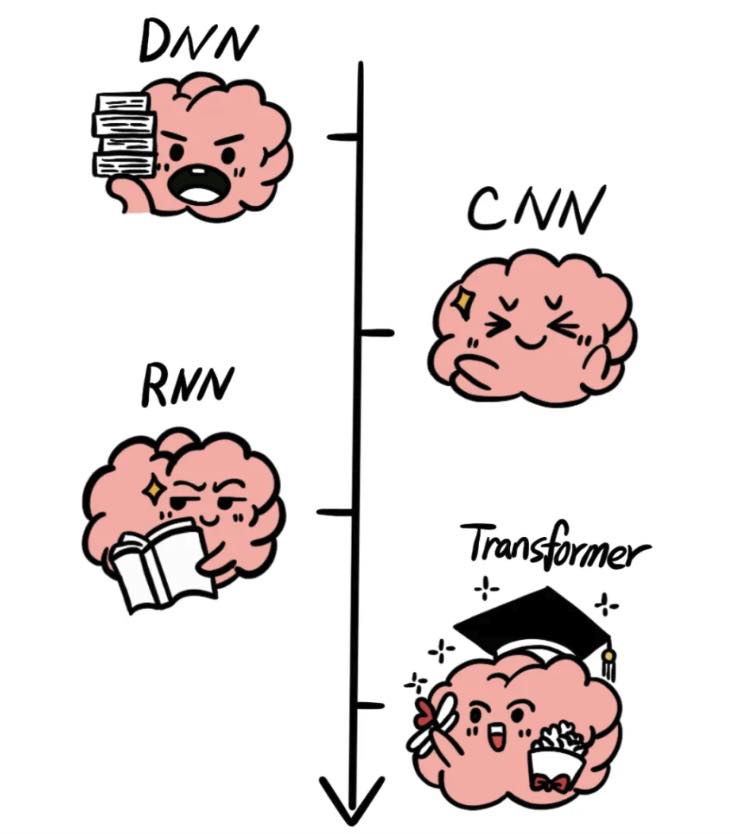
- Deep neural networks (DNNs) are the most common neural network architecture, but as data requirements for network architectures become increasingly complex, this approach has become increasingly difficult.
- A convolutional neural network (CNN) is an architecture designed specifically for processing image data. It can effectively process image data but requires complex preprocessing of the input data.
- As tasks become more complex, the recurrent neural network (RNN) architecture becomes a common method for processing sequence data.
- The famous Transformer algorithm was proposed because RNN is prone to gradient vanishing and model degradation problems when processing long sequences.
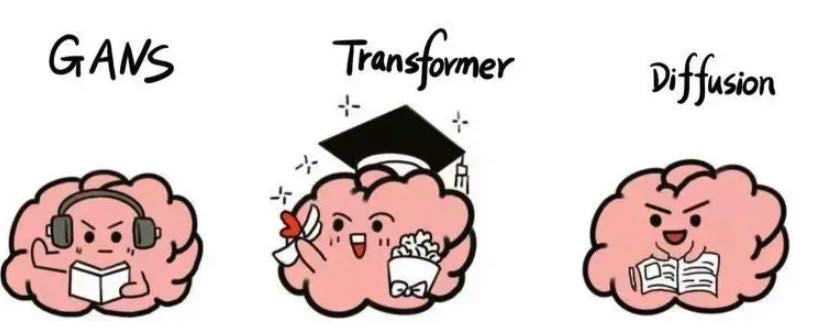
With the development of computing power, the network architecture of generative AI has become more and more mature, and has begun to focus on different aspects:
- Transformer architecture: It is the mainstream architecture in the current text generation field. GPT, llama2, and other LLMs (large language models) all achieve excellent performance based on Transformer.
- GANs architecture: It is widely used in image generation, video generation, and other fields, and it can generate high-quality image and video content.
- Diffusion architecture: It has achieved excellent results in areas such as image generation and audio generation and can generate high-quality and diverse content.
3. Feeding Knowledge – Data Training
There are currently two training methods: pre-training and SFT (supervised fine-tuning)
- Pre-training: this refers to feeding a large, general data set as knowledge to AI for initial learning. The pre-trained model is called a “base model”. It has some understanding of each field but cannot become an expert in a certain field.
- SFT: It means feeding a task-specific dataset to AI after pre-training to further train the model.
How Does AI Understand Knowledge?
But whether it is pre-training or SFT, how does the AI’s brain absorb this knowledge?
- Color dimension: Use 1 to represent red and 2 to represent green.
- Shape dimension: Use 1 for a circle and 2 for an ellipse.
- Watermelon : Color = 2 (green), Shape = 1 (round)
- Strawberry: Color = 1 (red), Shape = 2 (oval)
- Tomato : Color = 1 (red), Shape = 1 (round)
- Cherry : Color = 1 (red), Shape = 1 (round)

How Does AI Learn A Collection of Words?
- The image below is that of a green hat.

- Company X is committed to building a green computer room.


Therefore, in the Transformer architecture, it can be divided into the following two steps:
- Convert each word into a vector. This vector represents the position of the word in the multidimensional space and reflects the various characteristics of the word.
- Use a self-attention mechanism to focus on different parts of the sentence. It can consider the information of other words in the sentence while processing each word.
4. Output – Content Generation
AI Asks Everyone a Question:
- I eat in the restaurant.
- x Fill in a word; what would you fill in?
- Based on your past experience, you will most likely fill in “rice.”
- × can also mean “pancake”, “noodles”, “egg”, etc.
AI Temperature Ranging
- When the temperature is 0, the matching probability should be as large as possible. In the above example, AI is likely to choose “rice”;
- When the temperature is 1, the matching probability should be as small as possible. In the above example, AI is likely to choose “cake.”
How Does AI Modify Parameters?
- If your input is “You are an expert in a certain field. Please write a literature review about xx in a rigorous tone.” At this time, the AI temperature is close to 0, and it will choose words with the highest matching probability to generate sentences.
- If you input “Please imagine the future of xx.” At this time, the AI temperature is close to 1, and it will choose words with the lowest matching probability to form a sentence and generate unexpected content.
Where is “Generative AI” Going?
- Optimists: Optimists, led by OpenAI CEO Altman and Nvidia CEO Jensen Huang, are very optimistic about the future of generative AI. They have said that “in a few years, artificial intelligence will be more powerful and mature than it is now; and in another ten years, it will surely shine,” and “AI may surpass human intelligence within five years .”
- Negative faction: The negative faction, led by the deep learning pioneer LeCun, has always believed that generative AI cannot lead to artificial intelligence. He has repeatedly said that “large language models like ChatGPT will never reach the level of human intelligence” and “artificial intelligence trained by humans will find it difficult to surpass humans.”
Leave a Reply