The Tunnel Wave Resonance Unit, a tunnel-based RF waveguide resonator technology, uses the tunnel structure itself to improve mobile signal transmission.
The Tunnel Wave Resonance Unit is an emerging approach designed to solve one of the biggest challenges in modern mobile communication: maintaining reliable 5G connectivity inside high-speed rail and subway tunnels.
If you’ve ever travelled on a high-speed train or subway, you’ve probably experienced your mobile signal disappearing the moment the train enters a tunnel. Videos start buffering, live streams freeze, online games lag, and your phone may even switch from 5G to 4G before losing connection altogether.
Many people assume this happens because there aren’t enough mobile towers nearby. In reality, telecommunications engineers have long considered tunnel coverage one of the biggest challenges in mobile communications.
For years, network operators have relied on technologies such as leaky feeder cables and wall-mounted antennas to improve tunnel coverage. While these methods work to some extent, they are expensive to install, difficult to maintain, and often struggle to provide consistent signal quality.
Recently, Chinese Mobile network operators introduced an innovative technology known as the Tunnel Wave Resonance Unit, which aims to solve many of these long-standing challenges in tunnel communications.
Why Are Mobile Signals So Weak Inside Tunnels?
Providing reliable mobile coverage inside tunnels is far more complicated than covering open outdoor areas. Outside, radio signals travel freely with relatively few obstacles. Inside tunnels, however, several factors work against them.
Thick Tunnel Structures Block Radio Signals
Modern railway and subway tunnels are typically built from reinforced concrete and, in many cases, include metal shielding for additional protection.
These materials significantly weaken radio signals by blocking, reflecting, or absorbing them before they can enter the tunnel.
As a result, signals from outdoor base stations rarely penetrate deep enough to provide reliable coverage inside the tunnel.
High-Frequency Signals Lose Strength Quickly
Many modern mobile networks use higher-frequency spectrum to deliver faster speeds and greater network capacity.
For example, China Mobile’s 4.9 GHz spectrum offers excellent bandwidth but has relatively poor penetration and experiences greater signal loss over long distances.
Traditional tunnel coverage relies heavily on leaky feeder cables that distribute radio signals along the tunnel walls. However, high-frequency signals gradually weaken as they travel through these cables. This often creates a situation where users experience strong reception near the tunnel entrance but much weaker signals further inside.
Replacing or extending these cable systems is also costly, time-consuming, and can involve significant safety risks.
High-Speed Travel Makes Network Handover More Difficult
Passengers travelling on high-speed trains or modern subway systems move rapidly between different network cells. Traditional tunnel coverage divides tunnels into multiple sections, each served by different antennas or cable segments. As trains move between these coverage areas, mobile devices must quickly switch from one signal source to another.
At high speeds, these handovers may not complete smoothly, resulting in temporary signal drops, slower data speeds, or brief disconnections.
How the Tunnel Wave Resonance Unit Works
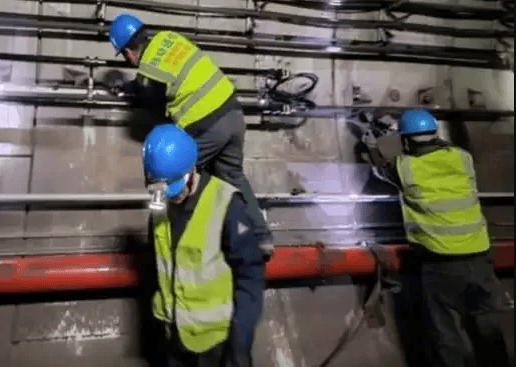 Instead of fighting against the tunnel’s structure, the Tunnel Wave Resonance Unit takes advantage of it. Its basic concept is surprisingly simple: use the tunnel itself as part of the transmission path.
Rather than installing long runs of leaky cables throughout the tunnel, only two compact excitation units are installed near each end.
These units generate radio frequency signals that interact with the tunnel’s metal-lined structure, creating what engineers describe as a waveguide effect. Imagine the tunnel as a giant hollow pipe.
Instead of allowing radio waves to spread in every direction, the tunnel guides the signals along its length, much like water flowing through a pipe. This greatly reduces energy loss and allows signals to travel farther while maintaining more consistent strength.
Advantages of the Tunnel Wave Resonance Unit
Compared with traditional tunnel coverage systems, this approach offers several significant advantages.
More Stable Mobile Signal
Traditional cable-based systems often experience noticeable signal loss as distance increases.
By contrast, the waveguide effect helps maintain a more consistent signal throughout the tunnel.
According to results reported during deployments, peak downlink speeds increased from approximately 700 Mbps to 2.2 Gbps, while overall network capacity improved by 125%.
The reported improvements also allowed passengers to stream ultra-high-definition video, participate in video calls, use cloud gaming services, and browse the internet more smoothly, even during busy commuting periods.
Faster Installation
Traditional tunnel upgrades require workers to install cables and antennas along the entire tunnel length. This work is labour-intensive, takes place in confined spaces, and often requires extended track closures.
The Tunnel Wave Resonance Unit significantly simplifies deployment.
Because only a small number of devices are installed, existing base station infrastructure can often be reused without major civil engineering work.
According to Liaoning Mobile, installation time at individual sites was reduced to around 90 minutes, while the overall construction period was shortened by approximately 80%. Shorter construction windows also improve worker safety and reduce disruption to normal railway operations.
Lower Construction and Maintenance Costs
Conventional tunnel coverage requires large quantities of cables, antennas, signal sources, and supporting hardware.
This increases equipment costs while making maintenance and troubleshooting more complicated.
The Tunnel Wave Resonance Unit dramatically reduces the amount of hardware required, simplifying deployment and lowering both installation and long-term maintenance costs.
Designed for Future Networks
Traditional leaky cable systems often require additional upgrades whenever mobile network technology advances.
The Tunnel Wave Resonance Unit has been designed to support modern 5G-Advanced (5G-A) network architecture, which is standardised through the work of 3GPP, making it more suitable for future capacity upgrades and higher-frequency deployments.
This could reduce future infrastructure replacement costs while supporting next-generation mobile services.
Final Thoughts
Reliable mobile coverage inside tunnels has challenged the telecommunications industry for decades.
Rather than relying solely on additional hardware, the Tunnel Wave Resonance Unit introduces a different approach by using the tunnel itself to guide radio signals more efficiently.
If the reported performance improvements continue to be demonstrated in wider deployments, this technology could become an important advancement for railway and subway communications, delivering more reliable connectivity for passengers while reducing deployment costs for network operators.
As 5G and 5G-Advanced networks continue to expand, innovations like this may help eliminate one of the last major mobile coverage blind spots.
Leave a Reply