As early as the beginning of this year, Samsung stated that it would shut down all its LCD panel production lines in South Korea and China by the end of this year, that is, it completely abandoned LCD production and shifted its production capacity to quantum dot display panels. it has now been officially confirmed that Samsung’s QD-OLED TV panels will be launched sometime in the year 2021.

Don’t Miss: Picture Quality Comparison between a Plasma, LCD, LED, OLED and Qled Televisions
What is Quantum Dot Display Technology?
By way of definition,
A quantum dot display is a display device that uses quantum dots (QD), semiconductor nanocrystals which can produce pure monochromatic red, green, and blue light.
Photo-emissive quantum dot particles are used in a QD layer which converts the backlight to emit pure basic colors which improve display brightness and color gamut by reducing light losses and color crosstalk in RGB color filters.
Samsung’s QD-OLED TV Panels: When will Mass Production Commence?
It is reported that Samsung Display plans to mass-produce OLED-based QD panels in the first half of year 2021. So, it is highly likely that Samsung Electronics will produce a TV with QD-OLED display next year.
Distinction Between QD-OLED, LED, LCD and OLED
Expectedly, many find it difficult to distinguish between quantum dots display, LEDs, LCDs, OLEDs for a while!
In simple terms, flat-panel TVs are divided into LCD and OLED TVs. The former(LCD) is based on backlighting and the latter is self-emitting. Since then, LED panels and quantum dot panels have been derived on the basis of LCD panel technology.
In addition, cold cathode fluorescent lamps(CCFL) are used in manufacturing traditional LCD panels, and white LED lamps used in LED TVs,
Basically, there is no difference in picture quality between the two, but LEDs are more energy-efficient, have lower heat generation and can be made thinner.
However, for quantum dot technology, it no longer uses white LED backlight but uses inorganic nanocrystals that can emit multiple colors as the backlight light source.
Comparatively, QD-LED has a higher color gamut coverage and more accurate color performance than others. Therefore, many quantum dot TVs and monitors on the market are marked with such things as 100% NTSC color gamut, 130% sRGB color gamut, which was unimaginable before.
Especially Relevant: Ways to Detect if an LED/LCD/OLED/Qled Television is Original or Fake
OLED screens use very thin coatings of organic materials and glass substrates, which emit light when current passes through them. OLED display screens can be made lighter and thinner, and at the same time, the viewing angle is also larger. The disadvantage is that there is a risk of burning the screen and the cost is also very high. For example, 65-inch OLED TVs are now priced at tens of thousands of yuan.
About Samsung’s QD-OLED TV Panels
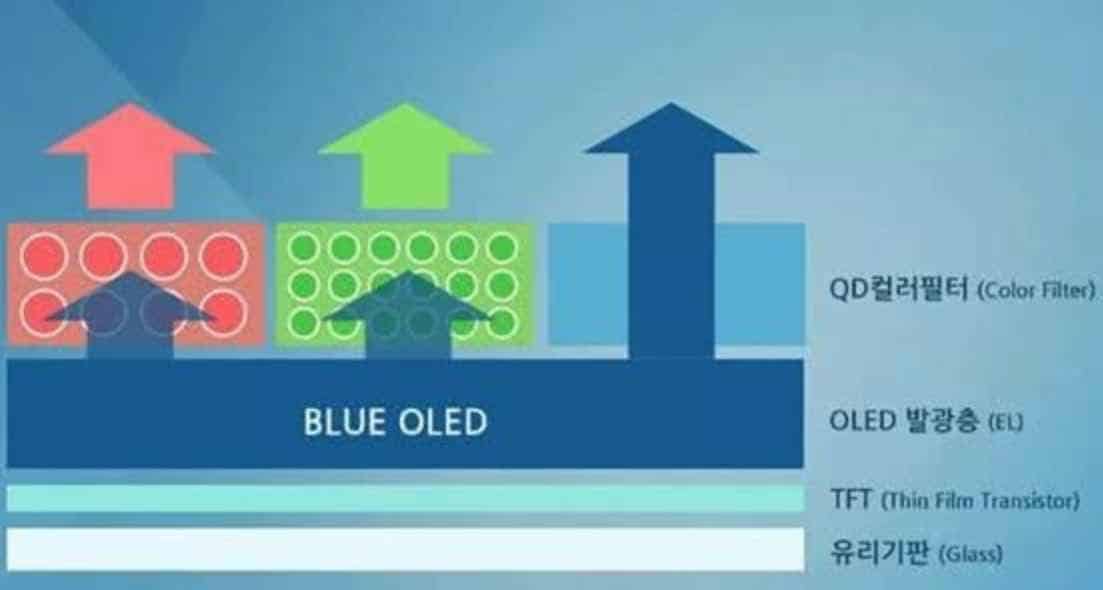
Samsung’s upcoming QD-OLED panel maintains the advantages of the OLED screen. At the same time, it combines quantum dot technology, so that the screen has an exaggerated color gamut and brightness.
Summarily, the working principle of QD-OLED is the combination of quantum dots and OLED. Under the framework of the original OLED screen, an additional light-emitting layer is added to emit blue light through the blue OLED.
Since the OLED in the QD-OLED panel emits only one color, the manufacturing difficulty and production cost are greatly reduced. It also has wider color gamut coverage and brightness performance than OLED.
Conclusively, the quality of QD-OLED panels can surpass OLED. But the price of QD-OLED is much lower than the OLED. This perspective makes QD-OLED a very promising display technology.
Hello and gudevening, plz how can I convert kwese decoder to FTA satellite one.. Have tried all the set up and procedure to follow but the manual search pop-up is not coming up is there anything else I need to do? Thanks in anticipation for ur reply!