The rapid growth of artificial intelligence (AI) is driving major developments in the optical communications industry. As AI models grow larger and more complex, the computing infrastructure needed to train and run them is expanding as well.
AI computing depends on powerful processors, including GPUs and other specialised computing accelerators. These processors are connected in large clusters, sometimes involving thousands or even hundreds of thousands of devices. For them to work efficiently, they must exchange enormous amounts of data at high speed. This is where optical communication technology becomes increasingly important.
Understanding Optical Circuit Switching (OCS): How It Works, Benefits and Challenges
Optical circuit switching (OCS) is one of the technologies attracting significant attention in the development of high-performance data centre networks. It allows optical signals to be routed directly between designated ports without first converting them into electrical signals for conventional packet switching.
Technology companies such as Google have already deployed OCS in large data centre networks, while other major industry players, including NVIDIA, Microsoft, Alibaba and Huawei, are exploring or developing optical networking technologies for AI infrastructure.
But what exactly is OCS? How does it work, why is it important, and where can it be used? More importantly, what are its advantages and limitations?
Let’s take a closer look.
What exactly is OCS?
OCS stands for Optical Circuit Switching. It is a switching technology that establishes a dedicated optical connection between an input port and an output port, allowing light to travel directly along a selected path.
To understand why this matters, it helps to look at how conventional electrical switching works and how optical communication has changed the way devices are connected.
In traditional electrical switching systems, electrical signals travel through copper connections between devices. As optical communication developed, optical fibres and optical transceivers became increasingly common. This meant that data could travel between network devices through optical fibres rather than copper cables.
However, introducing optical fibres did not necessarily eliminate electrical switching.
In many conventional networks, the signal still undergoes OEO (optical-electrical-optical) conversion.
Here’s how it works:
- An optical signal arrives at a network switch through an optical fibre.
- An optical transceiver converts the incoming optical signal into an electrical signal.
- The switching chip processes the electrical signal and determines where the data should go.
- The signal is converted back into optical form by another transceiver.
- It then travels through the outgoing optical fibre to its destination.
In other words, although optical fibres carry the data between devices, the switching process itself still takes place electronically.
We can compare this to a high-speed rail journey from Beijing to Shanghai with a transfer in Nanjing. Passengers travel from Beijing to Nanjing, get off the train, move to another platform and board a different train to continue their journey to Shanghai.
The journey involves an additional transfer before reaching the final destination.
OCS takes a different approach. Instead of converting the optical signal into electrical form for switching, it establishes a direct optical path between the input and output ports.
Using the same railway example, the train reaches Nanjing and simply changes tracks to continue towards Shanghai. Passengers do not need to get off and board another train.
This is the basic principle behind optical circuit switching.
Why move away from conventional electrical switching?
Electrical switching has served data centre networks extremely well, but the growing demands of AI computing are exposing some of its limitations.
There are several important considerations.

1. Power consumption
Electrical switching requires electronic components to process and forward data. As switching capacity increases, the power required by switching chips and their associated components also rises.
High-capacity switching equipment can consume hundreds of watts, while the largest configurations can exceed 1,000 watts. Cooling this equipment adds further demands on data centre power infrastructure.
OCS reduces the need for electronic processing within the switching fabric by allowing optical signals to pass directly between selected ports. This can significantly reduce switching-related power consumption.
The actual savings depend on the network architecture, port count, optical components and equipment being compared.
2. Transmission latency
Electrical switches must process incoming packets, make forwarding decisions and, where necessary, buffer traffic before sending it onwards.
OCS does not need to inspect individual packets to determine their destination. Once an optical connection has been established, the signal travels through the selected optical path.
This removes the need for repeated electrical packet processing at the OCS switching stage.
However, it is important to distinguish between data transmission latency and switch reconfiguration time. Although an established optical path can provide very low forwarding delay, many commercial OCS technologies, particularly MEMS-based systems, still require milliseconds to establish or change a connection.
3. Equipment and operating costs
Electrical switching relies on high-performance switching chips, optical transceivers and supporting components. As network capacity increases, the cost of upgrading this equipment can become significant.
OCS can reduce the need for some of these electronic switching components and potentially lower the overall cost of large-scale network infrastructure.
However, the cost advantage depends on the complete network design. OCS equipment, optical connections and network management systems also have their own costs.
4. Scalability
Conventional electrical switching capacity is closely linked to the capabilities of the switching chips and their available ports.
As network speeds increase from 400G to 800G, 1.6T and beyond, network operators may need to replace or upgrade switching equipment and optical transceivers.
OCS offers a different approach because the optical switching fabric can be largely independent of the data rate carried over the optical connection.
Provided the optical components and transmission system support the required signal, the same switching path can carry different generations of optical signals without necessarily replacing the OCS fabric itself.
This separation between switching capacity and optical transmission rate makes OCS attractive for networks that need to accommodate continuous increases in bandwidth.
It is particularly relevant to large AI computing clusters, where network capacity must grow alongside the number and performance of computing accelerators.
How does OCS work?
The basic operating principle of OCS is relatively straightforward, but implementing it is technically challenging.
Think about it: changing the direction of an electrical signal through a metal wire is not particularly difficult. But how do you change the direction of light travelling through an optical fibre?
How do you direct one incoming beam of light towards a selected output port without converting it into an electrical signal?
This requires specialised optical switching mechanisms capable of controlling the direction or propagation path of light.
Several technologies are being developed and used for this purpose. The main approaches include MEMS, piezoelectric beam steering, silicon photonics and liquid-crystal-based switching.
1. Micromirror arrays (MEMS)
MEMS stands for Micro-Electro-Mechanical Systems. It is currently one of the most established approaches for large-port-count optical circuit switching.

Companies such as Google and Lumentum have invested in MEMS-based OCS technology.
The principle involves using extremely small mirrors to redirect incoming light beams towards selected output ports.
A MEMS-based optical switch contains an array of movable mirrors. Electrical actuators control the position and angle of these mirrors, allowing the incoming optical beam to be redirected towards a designated output.
In some designs, two sets of mirrors work together to establish the required optical connection.
The mirror arrangement makes it possible to build switches with hundreds of input and output ports. Google’s Apollo OCS, for example, uses a three-dimensional MEMS architecture.
One of the main advantages of MEMS is its ability to support large switching fabrics while maintaining relatively low optical insertion loss.
However, because the mirrors move mechanically, switching and reconfiguration generally take milliseconds rather than nanoseconds. Mechanical movement also introduces potential reliability concerns, including actuator degradation and mirror-related faults.
Despite these limitations, MEMS remains an important technology for commercial OCS deployments, particularly where large port counts and stable optical connections are more important than extremely fast switching.
2. Piezoelectric ceramics and direct light beam steering

Another approach uses piezoelectric actuators to control the direction of optical beams.
This technology is often described as Direct Beam Steering (DBS) or direct light beam steering.
Piezoelectric materials change shape when an electrical voltage is applied. By controlling this movement, a system can adjust the position and angle of optical components with high precision.
In a typical beam-steering arrangement, optical collimators are positioned in opposing arrays. An electrical signal controls the piezoelectric actuators, moving or tilting the collimators until the incoming light beam aligns with the required output.
Unlike MEMS, which uses movable mirrors to redirect light, this approach can establish optical connections by physically aligning the optical beams.
One advantage is that it avoids the use of conventional micromirror arrays. Depending on the design, it can offer good optical performance, low insertion loss, and high reliability.
However, piezoelectric switching still involves mechanical movement. Its reconfiguration speed is therefore generally measured in milliseconds rather than nanoseconds.
Cost, actuator precision, and the complexity of maintaining accurate optical alignment are also important considerations.
You may also be interested in: A Brief History of Fiber Optics: From Early Experiments to Modern Networks
3. Silicon photonic waveguides (SiPh)
Silicon photonics uses semiconductor manufacturing techniques to integrate optical components and waveguides onto silicon-based chips.
Instead of directing light through free space using mirrors or movable optical components, silicon photonic switches guide light through carefully designed pathways within a photonic chip.
The switching process is controlled by changing the optical properties of these pathways. Depending on the design, this can involve thermo-optic, electro-optic, or other switching mechanisms.
One of the main advantages of silicon photonics is its potential for very fast switching. Some integrated photonic designs can operate at microsecond or even nanosecond timescales.
It also offers opportunities for compact integration and electronic control.
However, silicon photonic switching faces several challenges, particularly when manufacturers attempt to scale the technology to very large port counts.
These include optical insertion loss, signal crosstalk, manufacturing complexity and the difficulty of maintaining consistent optical performance across a large switching fabric.
Consequently, silicon photonics is promising, but its suitability depends on the required port count, switching speed and optical performance.
It is important not to assume that every silicon photonic switch offers the same performance. Results vary considerably between architectures and research implementations.
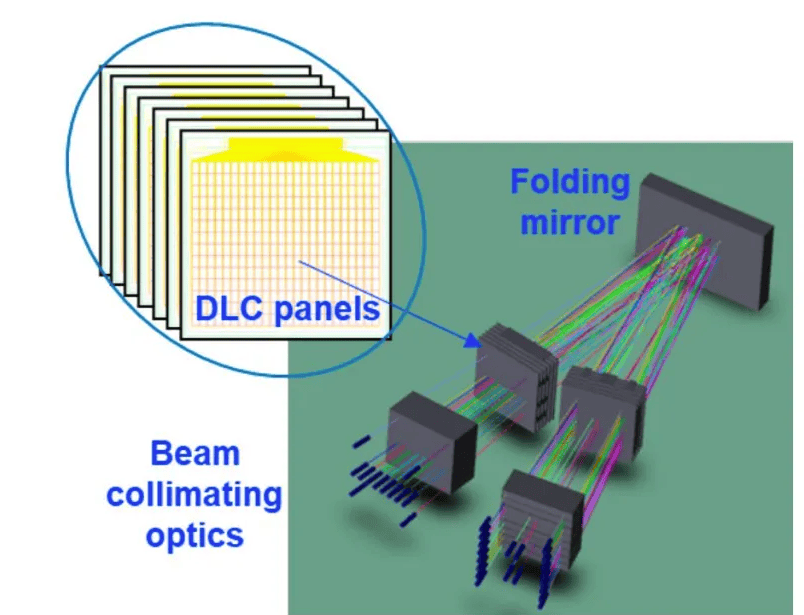
4. Liquid-crystal optical switching
Liquid-crystal technology provides another way to control the path of light.
Liquid-crystal optical switches use an external electric field to change the orientation and optical properties of liquid-crystal materials.
This alters how light passes through the material, including its phase or polarisation. With suitable optical components, the resulting changes can be used to redirect or switch optical signals.
Some implementations use liquid-crystal-on-silicon (LCoS) technology.
Liquid-crystal switching offers advantages in optical control and can be suitable for particular switching architectures. However, performance depends on the design, including its port capacity, insertion loss, switching speed, and optical stability.
It is therefore better to view liquid-crystal switching as one of several competing OCS approaches rather than assume it is universally superior to MEMS or piezoelectric systems.
Comparing the main OCS technologies
There is no single technology that is best for every application.
MEMS and piezoelectric beam-steering approaches are particularly relevant to large-port-count switching, while integrated photonic technologies offer opportunities for faster switching and smaller devices.
The Open Compute Project’s April 2026 white paper, Optical Circuit Switching for AI, provides a useful comparison of the different technologies and their characteristics.
You can read it here.
The important point is that switching speed, port count, insertion loss, reliability and cost must be considered together when selecting an OCS architecture.
What are the disadvantages of OCS?
The benefits of OCS are significant, particularly in large AI data centre networks. However, optical circuit switching also has limitations that make it unsuitable for every networking application.
1. Resource utilisation can be inefficient
Once an optical path has been established, the connection reserves network resources for the duration of that circuit.
If the connected devices have little or no data to exchange, the allocated optical path may remain underused.
This is different from conventional packet switching, where network capacity can be shared dynamically among multiple traffic flows.
As a result, OCS is generally more suitable for large, sustained data transfers and predictable communication patterns than for short, irregular bursts of traffic.
2. Switching speed is limited in many commercial implementations
As discussed earlier, MEMS-based OCS relies on physical mirror movement to establish or change optical connections.
This typically takes milliseconds, which is considerably slower than the packet-forwarding decisions made by modern electrical switches.
This distinction matters because AI computing networks can generate traffic that changes rapidly depending on the workload and communication requirements of the processors.
Although the data can travel very quickly once an optical path is established, repeatedly changing that path can introduce scheduling delays.
For this reason, conventional MEMS-based OCS is not a direct replacement for electrical packet switching in applications that require frequent, fine-grained forwarding decisions.
3. Limited fine-grained traffic control
OCS establishes connections between optical ports. It does not normally inspect individual packets or make forwarding decisions for each packet.
Its switching granularity is therefore much coarser than that of an electrical packet switch.
It also has limitations when handling dynamic multicast traffic, where the same data must be delivered to several destinations simultaneously.
Electrical switches can inspect packet headers, buffer traffic, apply forwarding rules and manage multiple data flows independently.
OCS does not provide the same level of packet-level control.
Another limitation is buffering. Conventional optical circuit switches generally do not have the electronic packet buffers found in electrical switches. When competing traffic needs the same resources, the network must manage the situation through its architecture and control system.
Optical buffering and contention management remain important research areas. A useful technical discussion of these challenges can be found in the research paper Nanosecond optical switching and control system for data centre networks.
4. Standards and interoperability are still developing
OCS technology is developing rapidly, but the wider ecosystem is not yet as established as conventional Ethernet switching.
Different manufacturers may use different hardware interfaces, management systems, control mechanisms and software implementations.
This can make interoperability more complicated, particularly when network operators want to combine equipment from different suppliers.
Network management protocols such as SNMP and NETCONF/YANG can support monitoring and configuration, but using these protocols does not automatically guarantee that different vendors’ equipment will work seamlessly together.
OCS also requires coordination with higher-level network applications and software-defined networking (SDN) controllers.
The network must know when to establish an optical path, which ports to connect, and when to reconfigure the topology.
This creates additional engineering and integration requirements.
For organisations considering OCS, these limitations should be evaluated alongside its potential benefits.
Where can OCS be used?
The most important application area for OCS today is large-scale AI computing infrastructure, particularly data centre networks.
As AI clusters grow, the amount of traffic exchanged between processors increases. Network architecture must therefore evolve to support higher bandwidth, lower power consumption, and more efficient communication.
OCS can contribute to this development in several ways.
1. Scale-up networks
Scale-up refers to connecting multiple computing accelerators within a system or supernode so that they can operate together as a larger computing unit.
OCS can provide flexible optical connections between different groups of processors, allowing network resources to be configured according to workload requirements.
This can be useful when the system needs to establish high-bandwidth connections between computing resources without relying entirely on conventional electrical switching.
2. Scale-out networks
Scale-out involves connecting multiple servers, racks or computing nodes to increase the overall capacity of a data centre.
In these environments, OCS can be used within the network fabric to establish direct optical connections between groups of computing resources.
One potential application is replacing or reducing some of the electrical switching stages in the upper layers of the network.
Because OCS switching is largely independent of the optical signal’s data rate, the same switching architecture can support different generations of optical connectivity, provided the associated components are compatible.
Its low switching-related power consumption and ability to reconfigure network topology make it attractive for large AI clusters.
Google’s Jupiter network is an important example of this approach.
3. Fault isolation and network reconfiguration
Large AI training jobs can involve thousands of processors working together. A failure affecting part of the network can disrupt the entire training process.
OCS offers the ability to change physical network connections through software-controlled optical switching.
If a particular connection or network segment develops a fault, the system can potentially reconfigure the optical topology to isolate the affected area and establish alternative connections.
This does not mean OCS automatically prevents failures or guarantees instant recovery. The effectiveness of fault management depends on monitoring, network control and the availability of alternative paths.
Nevertheless, the ability to reconstruct network connections is an important advantage in large computing environments.
4. Scale-across and data centre interconnection
Scale-across refers to connecting separate data centre facilities or geographically distributed computing resources.
OCS can support data centre interconnection (DCI) because of its ability to establish high-capacity optical connections over fibre infrastructure.
Its rate-independent switching architecture and scalability can be useful when operators need to connect different computing facilities or reorganise network capacity as demand changes.
However, the suitability of OCS depends on distance, optical transmission requirements, network topology and the level of control needed.
5. Metropolitan area networks
Beyond data centres, OCS is also attracting interest in metropolitan network applications.
Telecommunications operators are exploring ways to use optical switching to connect computing resources across different locations and create larger pools of AI inference capacity.
For example, an operator could connect several data centre facilities within a metropolitan area to support distributed AI workloads.
This could help make computing resources available across a wider geographical area without relying entirely on conventional electrical switching at every network layer.
Progress in OCS deployment: What are major technology companies doing?
OCS is moving beyond academic research and specialist optical networking applications. Large technology companies and telecommunications operators are increasingly interested in its potential for AI infrastructure.
However, it is important to distinguish between technologies already deployed in production and those still being evaluated or developed.
Google’s OCS deployment
Google is one of the leading companies behind the commercial development of OCS for data centre networks.
Its work on optical switching began years ago, as the company looked for ways to improve the capacity, efficiency and flexibility of its data centre infrastructure.
A major development was Google’s Apollo optical switching system, which uses a three-dimensional MEMS architecture.
In its 2022 research paper, Mission Apollo: Landing Optical Circuit Switching at Datacenter Scale, Google described the challenges involved in deploying OCS at production scale.
The company explained how its system uses optical switching to establish direct connections between network aggregation blocks, allowing the data centre network topology to be reconfigured dynamically.
Google also published its experience with the Jupiter data centre network in the paper Jupiter Evolving: Transforming Google’s Datacenter Network via Optical Circuit Switches and Software-Defined Networking.
The paper describes how MEMS-based OCS, combined with software-defined networking and traffic engineering, helped Google move towards a more flexible network architecture.
According to the research, the evolution of Jupiter delivered five times higher speed and capacity, a 30% reduction in capital expenditure and a 41% reduction in power consumption over the period discussed.
These improvements were achieved through several architectural changes, including OCS deployment, rather than being attributable to the optical switches alone.
Google’s experience is particularly important because it demonstrates that OCS can operate at the scale required by major production data centres.
NVIDIA’s interest in optical networking
NVIDIA is another major player in the development of AI networking infrastructure.
The company’s AI platforms depend on high-speed communication between large numbers of GPUs, making network bandwidth, power consumption and topology increasingly important.
NVIDIA has invested heavily in high-performance networking technologies, including InfiniBand, Ethernet and co-packaged optics.
OCS is relevant to this wider development because it offers a way to create flexible optical connections between computing resources.
There is considerable industry interest in combining optical switching with emerging AI network architectures, including systems designed around large GPU clusters.
However, it is important to distinguish NVIDIA’s broader optical networking strategy from confirmed large-scale commercial OCS deployments. Specific claims about future Feynman-based OCS architectures or planned deployment dates should be treated as projections unless supported by an official NVIDIA announcement.
Progress among telecommunications operators and Chinese manufacturers
Developments are also taking place across the Chinese telecommunications and optical equipment industries.
Huawei has been associated with research and development in optical switching and AI data centre interconnection. Its wider AI infrastructure strategy also places increasing emphasis on high-speed connections between computing resources.
China Telecom has reported progress in OCS-based data centre networking.
A presentation at the 2026 Optical Fibre Communications Conference (OFC), published through the International Telecommunication Union’s study group materials, described an OCS-based data centre network architecture and reported results from laboratory and field evaluations.
The reported results included:
- A 14% reduction in GPU point-to-point latency.
- A 19% reduction in network power consumption.
- A 17% improvement in reliability.
These figures relate to the specific architecture and test conditions reported. They should not be interpreted as guaranteed improvements for every OCS deployment.
China Mobile has also identified optical networking as part of its wider intelligent computing network development.
The wider OCS supply chain
The growth of OCS is creating opportunities for companies involved in optical components, switching systems and semiconductor technologies.
Companies such as Accelink Technologies, Innolight and Eoptolink operate in the wider optical communications industry.
The supply chain involves much more than the finished optical switch. It includes components and technologies such as:
- MEMS micromirror arrays.
- Optical lenses and collimators.
- Fibre arrays and optical connectors.
- Silicon photonics chips.
- Liquid-crystal optical components.
- Driver ASICs and FPGAs.
- Precision packaging and alignment systems.
- Optical testing and calibration equipment.
- Network control and management software.
Manufacturing consistency, optical performance, reliability and production yield remain important challenges as the industry moves towards larger-scale deployment.
How large could the OCS market become?
The increasing demand for AI computing infrastructure is creating new commercial opportunities for optical circuit switching.
As data centre operators build larger GPU and TPU clusters, they need networking technologies that can deliver higher capacity without increasing power consumption and infrastructure costs at the same rate.
This has attracted the attention of optical equipment manufacturers and market research companies.
Cignal AI has published several forecasts for the OCS market as new applications and commercial deployments emerge.
Its December 2025 report projected that the external OCS market would reach at least $2.5 billion by 2029.
However, the forecast was subsequently revised upwards. In July 2026, Cignal AI reported that its updated market outlook projected the global OCS market to exceed $8 billion by 2030.
The revised outlook reflects the growing importance of OCS in both scale-out and emerging scale-up applications.
You can read Cignal AI’s July 2026 OCS market update.
These figures are market forecasts, not confirmed future revenue. Actual growth will depend on deployment rates, technology maturity, manufacturing capacity and the adoption of OCS by major data centre operators.
Nevertheless, the direction of investment shows that OCS is becoming an increasingly important part of the optical networking industry.
Conclusion: Is OCS the future of AI networking?
The growing importance of OCS is difficult to ignore.
AI computing clusters are expanding, and the demand for faster communication between processors continues to increase. At the same time, the power consumption and cost of conventional electrical switching are becoming major considerations for data centre operators.
OCS offers a promising alternative by allowing optical signals to travel directly between selected ports without the repeated optical-electrical-optical conversion associated with conventional electrical switching.
Its advantages include lower switching-related power consumption, reduced processing overhead, high bandwidth and the ability to reconfigure network topology.
However, widespread adoption will not happen overnight.
There are still challenges involving switching speed, resource utilisation, optical losses, reliability, interoperability and network management. The technology also needs to mature further before it can be deployed economically across every type of network.
More importantly, electrical switching and optical switching are likely to coexist for many years.
Electrical switches remain essential for fine-grained packet processing, traffic management, buffering, multicast and other functions that conventional OCS cannot easily perform.
OCS, on the other hand, is particularly attractive for large, sustained data flows and predictable communication patterns where establishing dedicated optical paths makes economic and technical sense.
The two technologies should therefore not be viewed simply as competitors. They are more likely to complement each other, with electrical switching handling packet-level decisions and optical switching providing high-capacity connections where it offers the greatest benefit.
Looking ahead, OCS will continue to evolve. Larger port counts, lower insertion losses, faster reconfiguration, improved reliability and better integration with network control systems will all be important areas of development.
As these challenges are addressed, optical circuit switching could become one of the key technologies supporting the next generation of AI data centre networks.
Leave a Reply