On May 24, while the global tech media fixed their eyes on the Google I/O Developer Conference, OpenAI made a surprise move by acquiring AI hardware startup io, founded by former Apple chief designer Jonathan Ive, for $6.5 billion. This unexpected technological strike on Google’s home turf immediately sent shockwaves through the industry. With Ive’s team on board, OpenAI gained access to world-class hardware design capabilities for the first time, sparking endless speculation about the nature of this mysterious new product. Without much ado, let’s delve into the OpenAI Hardware Speculation Storm.

Although no official details have been revealed yet, that hasn’t stopped the internet from erupting into a frenzy of imagination. From wild guesses and stunning concept renderings to serious industry analysis and a flood of meme-driven culture, the entire tech world seems to be engaged in a collective thought experiment.
OpenAI Hardware Speculation Storm: Imagining OpenAI’s First AI Device
So here’s the big question: What does the ChatGPT device — the product of a collaboration between OpenAI and a world-renowned design team look like? Is it a screenless wearable that breaks from tradition? A new benchmark for smart assistants? A pocket-sized AI oracle? Or perhaps just a beautifully designed tech ornament? We’ve collected the most representative predictions from across the web — from serious industry forecasts to tongue-in-cheek speculation:
01. Rational Analysis: Insights from Top Analysts
Amid the noise of speculation, we begin with the authoritative voices of industry professionals.
TF Securities analyst Ming-Chi Kuo, widely respected for his accurate predictions about Apple’s supply chain, laid out a technical vision of what OpenAI’s mysterious device might entail:
A Miniaturized Aesthetic Icon: The device, which is expected to be roughly the size of an iPod Shuffle, would follow Ive’s hallmark minimalist design philosophy.
Revolutionary Wearable Form: The rumored neck-worn design has stirred debate, described as a cross between the Star Trek communicator badge and an ultra-evolved electronic pet.
A Screen-Free Revolution: The device reportedly omits a screen entirely to promote “interference-free AI” by using a multi-spectral environmental sensing module (combining cameras and microphone arrays).
Distributed Computing Architecture: As a lightweight terminal, it relies on smartphones or computers to handle complex processing and visual output, signaling a new collaborative device ecosystem.
Mass Production Forecast: Large-scale manufacturing is projected for 2027, allowing time for concept refinement and market positioning.
On social platform X, Kuo noted that the product’s launch timing was no accident—it was a strategic countermove to Google I/O and part of OpenAI’s broader narrative to introduce “Physical AI” into the mainstream. He also referenced the philosophy of legendary Apple engineer Alan Kay, who once said, “People who are really serious about software should make their own hardware.” According to Kuo, this move perfectly encapsulates the Altman-led team’s bold step into the physical world, which could fundamentally reshape the landscape of AI competition.
02. Clues Provided by Altman and the Media
At a later internal meeting, OpenAI CEO Sam Altman and Jonathan Ive jointly unveiled a bold and disruptive initiative codenamed “Family of Devices.” Positioned as the “core terminal of the post-smartphone era,” this innovative product is slated for release in Q4 2026 and is designed to redefine human-computer interaction through the revolutionary concept of ambient intelligence.
The device features a modular design and is roughly the size of a business card box. It supports adaptive form transformations and integrates a multimodal sensor array capable of creating a digital twin of its environment with centimeter-level precision. With a breakthrough contactless interaction system, users can engage with it naturally and intuitively, with virtually zero learning curve.
The Ive-led design team revealed three core form factors:
A neck-worn smart pendant
A magnetic desktop terminal
A flexible patch-style wearable device
While the team expressed some reservations about wearable formats, the device is intended to break away from traditional smartphones and smart glasses, signaling a new design category altogether.
According to OpenAI’s mass production roadmap, the company plans to adopt a “Tesla-style” capacity ramp-up strategy, targeting 100 million units delivered per year by 2030. Altman emphasized that the device will generate recurring revenue via subscription-based AI services, with a business model valuation expected to surpass traditional hardware by an order of magnitude, potentially pushing OpenAI’s overall valuation beyond the $1 trillion mark.
03. Conceptual Fantasy: A Brainstorm Lab Where Reality and Imagination Interweave
Design visionary Ben Geskin — a well-known tech insider famous for accurately leaking unreleased devices — gave us a taste of what’s to come with his latest cyberpunk-inspired concept renderings, shared on X. His visual interpretations offer a futuristic “afternoon tea” of form and fantasy, blending sharp aesthetics with speculative tech design.
There are also smart glasses, which are a must!
A small dangling pendant that looks like both a technological product and a piece of jewelry.
There are also square objects that exude a mysterious and elegant style.

By the way, a friend on X also echoed Geskin and proposed an idea for a disc-shaped device that is both high-end and can easily be used as a coaster or a futuristic ice hockey puck. You can think of it as an AI desktop assistant, with ears standing up straight, “obediently” listening quietly on the desktop, and with a little halo, like a shy elf.

An X user came up with an idea to make a smart ChatGPT lamp, which might be inspired by the episode in The Sopranos where the FBI bugged Tony’s basement. Although it sounds funny, it is not completely impossible. After all, a desk lamp is very suitable for placing on the table, which just meets the “desktop-friendly” standard proposed by Altman.

Another user joked on X that if this thing is made like the neck hanging device for the elderly, it will probably work well – “Help! I fell and can’t get up!” Just replace the nurse with ChatGPT. Although this joke is a bit exaggerated, it also reminds us: if this device can be turned on 24 hours a day, can automatically respond according to the context, and can even be carried around, then why not try to expand the market to the elderly user group?

However, if it’s for the elderly, shouldn’t it be Google Gemini? Oh, this is Versailles!
User X Peter Hu came up with the idea of an AI nail clipper. Yes, it’s ridiculous; no, it doesn’t make sense. But the design is actually pretty cool!

Someone even joked about an e-cigarette pen with ChatGPT elements: “Inhale wisdom and exhale existential anxiety.”

Some surreal concept designs look like they’re inserted directly into your head. This design evokes a strong sense of déjà vu—like something out of The Matrix or A Life Divided—as if depicting a future world where ChatGPT is a caring parasite, living in your brain, ready to serve at any moment.

The design above is so cute, it’s almost unfair!
ChatGPT tried it, but the result was underwhelming. No wonder OpenAI spent $6.5 billion to acquire Ive’s hardware design startup and try to save the day.
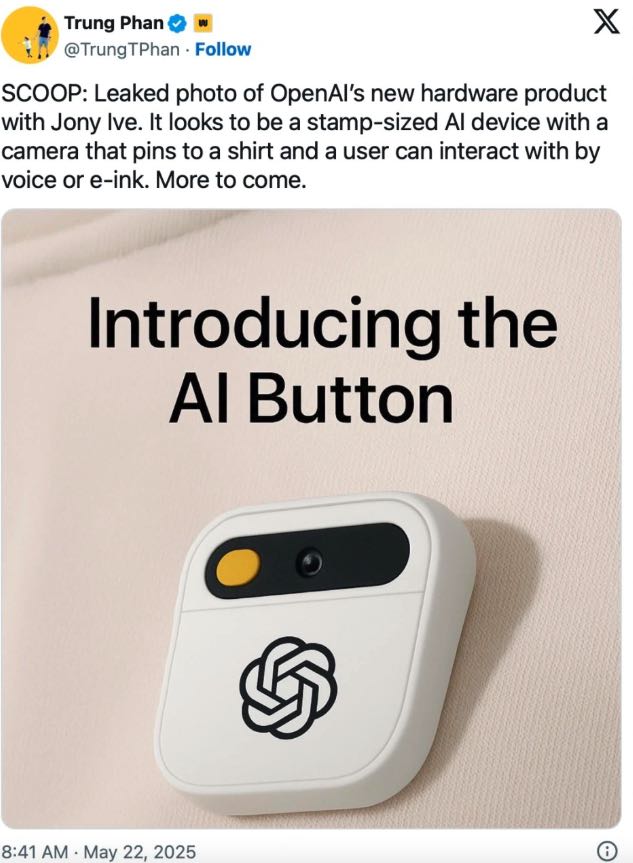
The last design is something of an inside joke in Silicon Valley and a stark reminder that smartphones are a tough act to follow. It’s a clear nod to the infamous failure of Humane’s AI Pin. If OpenAI’s ChatGPT device resembles this, many fear it could share the same fate.
04. Can OpenAI Compete with Google and Apple?
This device matters not just because of its looks, but because of what it represents.
Today, Apple and Google control the computing interface layer through their iOS and Android ecosystems. If OpenAI wants to define how people interact with ChatGPT in everyday life, it needs to secure a hardware beachhead—its own platform.
Humane’s AI Pin attempted, but stumbled. The Rabbit R1 faced widespread criticism. The market is still trialing Meta’s Ray-Ban smart glasses. So the question remains:
Can Ive and Altman succeed where others have failed?
When it comes to Ive, expectations are always high. Whatever he’s building is almost guaranteed to turn heads—and just maybe, the final product will defy all expectations.
The race to define the next central computing interface is officially on. With Ive and Altman teaming up, OpenAI is placing a bold bet: how we interact with AI is just as important as the intelligence itself.
When the design teaser video dropped and I whispered just one word—”aluminum,” jaws dropped, and competitors quietly scrambled to catch up.
Until then, keep imagining. The form of this future device remains a mystery, but one surrounded by excitement, speculation, and ambition. We’ll be watching closely as this remarkable story unfolds. See you in 2027.
I have Q-SAT Q28G no signal