In the context of global energy transformation, innovation in battery technology is becoming a key force in promoting sustainable development. Recently, scientists made a breakthrough in this field and developed the world’s first anode-free sodium solid-state battery. This innovation is not only expected to completely change the battery industry’s landscape but also may bring us cheaper, more efficient, and safer energy storage solutions. In this post, I will discuss the anode-free sodium battery Revolution.
From Lithium to Sodium: A New Direction for the Battery Revolution
Over the past few decades, lithium-ion batteries have become standard equipment for electric vehicles and mobile devices due to their high energy density. However, as the demand for batteries has grown dramatically, the scarcity and rising prices of lithium resources have begun to cause concern. This situation has prompted scientists to continue looking for alternatives. Sodium has gradually become an attractive option due to its unique advantages.
Sodium-Based Batteries: What Are the Advantages?
The sodium reserves in the earth’s crust are about 1,000 times that of lithium. This astonishing figure means that the supply of raw materials for sodium batteries will be more sufficient and stable.
The abundant reserves will greatly reduce the production cost of batteries, making large-scale applications possible. In addition, the mining and refining process of sodium has relatively little impact on the environment, which is more in line with the requirements of sustainable development.
These advantages make sodium-based battery technology a vital development direction in the field of energy storage in the future.
Challenges of Sodium-Based Batteries.
However, the shift to sodium-based batteries is not without challenges. Conventional sodium-ion batteries are still difficult to match with lithium-ion batteries regarding energy density and cycle life.
This requires scientists to develop new battery architectures and materials to overcome these limitations. Anode-free battery design emerged in this context, bringing new hope and possibilities to sodium battery technology.
Anode-Free Design: Innovative Approach that Subverts Tradition
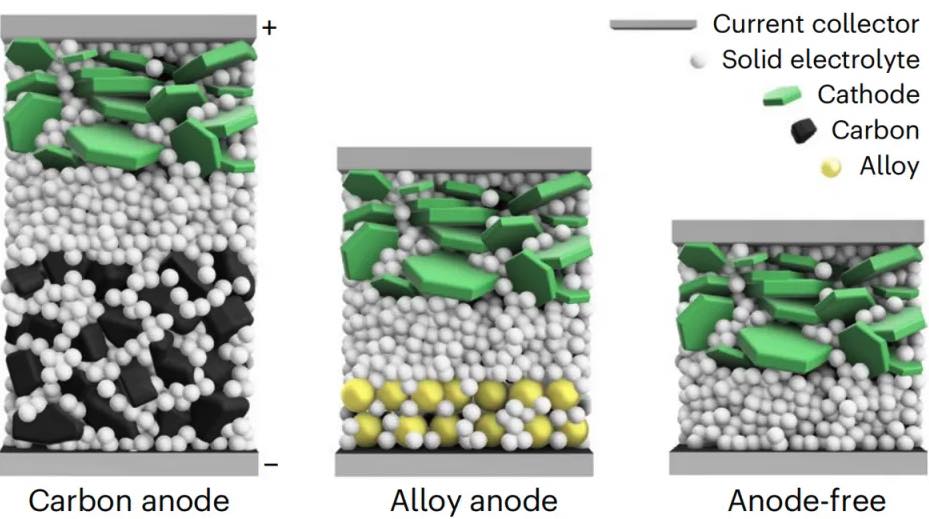
To understand the revolutionary nature of anode-free batteries, we first need to review the basic structure of traditional batteries. Traditional batteries usually contain three main parts: cathode, anode, and electrolyte. During charging, ions migrate from the cathode to the anode and are stored there; during discharge, ions flow from the anode back to the cathode through the electrolyte to generate current.
This design has been used for decades but faces challenges such as energy density limitations and safety issues.
The innovation of anode-free batteries is that the anode component is wholly removed. In this new design, when charging, ions are stored directly on the surface of the current collector by electrochemical deposition.
When discharging, ions are separated from the surface of the current collector and returned to the cathode through the electrolyte. This seemingly simple change brings a series of significant advantages:
Anode-Free Sodium Battery Revolution
- First, removing the anode reduces the battery’s weight and volume, thereby increasing its overall energy density. This means that a battery of the same size can store more energy, or a battery of the same capacity can be made smaller and lighter.
- Secondly, the simplified structure reduces production costs, critical for large-scale commercialization.
- In addition, the anode-free design can also achieve higher battery voltages, further improving energy density.
However, the anode-free design also brings new technical difficulties. The main challenge is ensuring good contact between the electrolyte and the current collector without a traditional anode.
This is crucial for the effective transportation of ions and directly affects the battery’s performance and life. To overcome this problem, the research team adopted two key innovations: the application of solid-state electrolytes and the innovative current collector design.
Solid-State Electrolytes: Dual Guarantee of Safety and Performance

The research team used a solid electrolyte instead of the traditional liquid electrolyte in the anode-free sodium solid-state battery. This choice not only solves the key problems in the anode-free design but also brings a series of additional advantages.
- The most notable feature of solid electrolytes is their high safety. Unlike flammable liquid electrolytes, solid electrolytes greatly reduce the risk of battery fire or explosion. This feature is crucial for electric vehicles and large-scale energy storage systems, which can significantly improve the safety performance of the entire system.
- Secondly, solid electrolytes improve battery stability and life. Compared with liquid electrolytes, solid electrolytes do not produce harmful interfacial reactions, which usually cause battery performance to decline gradually over time. Therefore, batteries using solid electrolytes can maintain high performance for a longer period, extending the effective service life of the battery.
- In addition, solid electrolytes show excellent stability in high-temperature environments. This means that devices using this battery can work normally in a wider temperature range, expanding the battery’s application scenarios. For example, this feature will be important in outdoor equipment or industrial applications under extreme climate conditions.
However, the application of solid-state electrolytes also brings new challenges. The main issue is ensuring good contact between the solid-state electrolyte and the electrode material. This problem becomes particularly critical in anode-free designs because no traditional anode structure assists interfacial contact. The research team developed an innovative current collector design to address this issue.
Innovative Current Collectors: a Breakthrough solution for Interfacial Contact
The research team developed a unique and ingenious current collector design to solve the problem of contact between the solid electrolyte and the current collector. They built the collector using solid aluminum powder with liquid-like fluidity. This seemingly contradictory material choice is the key to solving the problem.
Aluminum powder is compacted under high pressure during the battery assembly to form a solid current collector. What is unique about this process is that, despite the final strong solid structure, the aluminum powder, due to its fluidity in the initial state, is able to fill all the tiny voids and irregular surfaces during the compaction process.
This innovative collector design cleverly solves the critical problem in solid-state batteries. It not only ensures the collector’s mechanical strength and conductivity but also achieves close contact with the electrolyte, which is almost comparable to the contact effect of a liquid electrolyte.
This close contact is crucial for the efficient transmission of ions and directly affects the battery’s charge and discharge efficiency and overall performance.
More importantly, this design provides a stable interface for the deposition and detachment of sodium ions in anode-free batteries. During the charging process, sodium ions can be evenly deposited on the surface of the current collector to form a temporary “anode” layer.
During the discharge process, these sodium ions can smoothly detach from the surface of the current collector and return to the cathode through the electrolyte. This reversible process is the key to the efficient operation of anode-free batteries.
This innovative current collector design not only solves technical problems but also paves the way for the commercialization of anode-free sodium solid-state batteries. It proves that high-performance solid-state batteries are possible in practical applications, which has important implications for the entire battery industry.
Performance and Application: The Key to Opening the New Energy Era
Based on these innovative designs, the new anode-free sodium solid-state battery has demonstrated impressive performance. According to the research team’s report, this battery’s energy density is comparable to that of the current mainstream lithium-ion battery, which is a major breakthrough. High energy density means that the same battery volume can store more energy, which is particularly important for its application in electric vehicles and other fields.
The new battery also performs well in terms of cycle life. Tests show that the battery structure remains stable and can withstand hundreds of charge and discharge cycles without significant performance degradation. This long-life feature is of great significance for reducing the cost of battery use and electronic waste.
Another significant advantage of the new battery is its fast charging capability. The innovative anode-free design and efficient ion transport interface allow the battery to withstand higher charging currents, which means users can fully charge their devices in a shorter time.
Safety is one of this battery’s most outstanding features. The solid-state design and the use of sodium greatly improve the battery’s safety, almost eliminating the risk of battery fire or explosion. This feature is vital for electric vehicles and large-scale energy storage systems, which can significantly improve the safety performance of the entire system.
Conclusion
The successful development of anode-free sodium solid-state batteries marks a new stage in the development of battery technology. This innovation not only overcomes many limitations of traditional battery design but also fully utilizes the advantages of sodium elements, providing us with a more economical, environmentally friendly, and efficient energy storage solution.
Although this technology is still in the laboratory stage, its great potential has attracted widespread attention from academia and industry. With further research and optimization, we have reason to believe that anode-free sodium solid-state batteries will emerge from the laboratory in the near future and have a profound impact on our daily lives and industrial production.
Leave a Reply