For decades, passengers have accepted one major limitation of air travel: once an aircraft reaches cruising altitude, reliable internet access becomes difficult, expensive, or unavailable. However, 5G-ATG air-to-ground communication is emerging as a potential solution that could bring faster, lower-latency connectivity to aircraft by using specially designed ground networks.

Imagine travelling at 10,000 metres above the ground while streaming high-definition videos, joining video conferences, playing online games, or accessing cloud applications with an experience closer to what you get on the ground.
That vision is driving renewed interest in Air-to-Ground (ATG) technology.
In July 2026, a strategic collaboration involving major players from the telecommunications, aviation, aircraft manufacturing, and network equipment industries highlighted the increasing attention surrounding 5G-ATG technology. The partnership brought together representatives from different parts of the aviation connectivity ecosystem, including telecom operators, airlines, aircraft manufacturers, and equipment suppliers.
The announcement raised an important question:
Has ATG finally reached the stage where large-scale commercial deployment is realistic?
More importantly, compared with satellite-based internet services, does ATG offer a genuine advantage?
To answer these questions, we first need to understand what ATG actually is and why the aviation industry has been searching for better connectivity solutions for so long.
What Exactly Is ATG (Air-to-Ground Communication)?
ATG stands for Air-to-Ground communication.

Unlike traditional mobile networks designed primarily for users on the ground, ATG is specifically engineered to provide communication services to aircraft travelling through the sky.
The basic idea is relatively simple:
Instead of connecting an aircraft directly to a satellite, ATG uses a network of specially configured ground stations positioned along major flight routes.
These ground stations use antennas designed to transmit signals upwards towards aircraft, creating a dedicated communication link between the aircraft and the ground network.
The aircraft then uses onboard communication equipment to connect passengers and crew members to internet services.
The concept is similar to how mobile phones connect to terrestrial cellular networks, except the coverage direction is reversed.
Traditional mobile networks focus on transmitting signals horizontally across the ground.
ATG networks are designed to transmit and maintain connections vertically with aircraft moving hundreds of kilometres per hour above the Earth.
Why Does In-Flight Connectivity Matter?
In today’s connected world, internet access has become an expectation rather than a luxury.
People rely on smartphones, messaging applications, video platforms, cloud services, and online work tools throughout their daily lives.
However, air travel remains one of the few situations where people often lose reliable connectivity for several hours.
The average commercial flight lasts around two and a half hours, meaning passengers can spend significant periods disconnected from:
- instant messaging services;
- entertainment platforms;
- work communication tools;
- social media;
- online services.
For many travellers, especially business users, staying connected during flights is increasingly important.
Missing an urgent email, delaying a business decision, or being unable to participate in an online meeting can have real consequences.
According to research from Inmarsat, passenger demand for reliable in-flight connectivity has continued to increase, with internet availability becoming an important factor influencing airline passenger experience.
Beyond Passenger Entertainment: ATG Has Important Aviation Applications
Although passengers often associate aircraft connectivity with entertainment, ATG has much broader applications.
An aircraft can generally be divided into two main areas:
- the cabin, where passengers and flight attendants are located;
- the cockpit, where pilots operate the aircraft.
While passenger services focus mainly on internet access, cockpit connectivity can support operational applications that improve efficiency and safety.
Examples include:
- aircraft health monitoring;
- real-time aircraft performance data;
- flight information updates;
- weather information;
- operational communication between aircraft and ground teams.
One important application is the Electronic Flight Bag (EFB).
Electronic Flight Bags replace traditional paper-based aviation documents with digital systems that allow pilots to access important information electronically.
Through reliable connectivity, pilots can receive updated:
- route information;
- weather data;
- airport information;
- operational updates.
International aviation organisations such as ICAO (International Civil Aviation Organization) continue to support the development of safer and more efficient digital aviation systems.
Improving Aircraft Safety Through Real-Time Data
Most people are familiar with aircraft black boxes.
These flight recorders store important aircraft information, but traditionally, the data is only recovered after an incident.
With reliable aircraft connectivity, more operational data can potentially be transmitted to the ground in real time.
This could provide airlines and maintenance teams with earlier visibility into:
- aircraft system conditions;
- unusual performance patterns;
- potential technical issues.
ATG connectivity could also support emergency assistance.
For example, if a passenger experiences a medical emergency during a flight, better connectivity could allow ground support teams to provide faster assistance by sharing information with cabin crew.
The Two Main Ways Aircraft Can Connect to the Internet

At present, there are two major approaches for providing internet connectivity on aircraft:
- Satellite communication
- Air-to-Ground communication
Each method has different advantages and limitations.
Satellite connectivity has been the dominant approach for many years because satellites can provide coverage over large geographic areas, including oceans and remote regions.
However, ATG has attracted attention because it addresses several weaknesses associated with satellite-based systems.
Satellite Communication vs ATG: Which Technology Has the Advantage?
Currently, satellite communication and Air-to-Ground (ATG) systems represent the two main approaches for providing internet connectivity to aircraft.
Satellite communication works by installing communication equipment on the aircraft that connects directly to satellites orbiting the Earth.
This approach has one major advantage: global coverage.
A satellite does not need physical infrastructure along flight routes, making it suitable for international flights, ocean crossings, and remote regions where ground networks cannot be deployed.
However, satellite connectivity also has several limitations.
The Challenges of Satellite-Based Aircraft Internet
1. Limited Network Speed
Although modern satellite systems have improved significantly, available bandwidth remains a challenge.
Different satellite technologies provide different performance levels depending on orbit type, frequency band, and network design.
For example, low-throughput satellite systems generally provide limited capacity, while high-throughput satellites improve performance through better frequency reuse and greater bandwidth efficiency.
However, the actual experience passengers receive depends on many factors, including:
- the number of passengers sharing the connection;
- satellite capacity;
- aircraft equipment;
- ground network infrastructure.
Even when the theoretical bandwidth looks impressive, real-world passenger speeds may be much lower.
2. Higher Communication Latency
Latency is another major limitation.
The distance between aircraft and satellites can introduce noticeable delays.
High Earth orbit satellites, such as geostationary satellites positioned approximately 36,000 kilometres above Earth, create significant signal travel distances.
This affects applications that require fast response times, including:
- online gaming;
- video conferencing;
- interactive cloud applications.
Low Earth orbit (LEO) satellite systems reduce this problem because satellites operate much closer to Earth.
However, even LEO systems still require complex satellite networks, ground stations, and handover management between moving satellites.
3. Higher Infrastructure Costs
Satellite communication requires enormous investment.
The costs include:
- satellite design and manufacturing;
- rocket launches;
- orbital management;
- ground stations;
- maintenance and replacement.
Satellites also have limited operational lifespans.
Depending on the orbit and technology, satellites may require replacement after several years, creating ongoing investment requirements.
These costs eventually affect the price passengers pay for onboard connectivity.
Why 5G-ATG Could Be a Strong Alternative
Compared with satellite connectivity, ATG takes a different approach.
Instead of communicating with satellites in space, aircraft communicate with specially designed ground stations.
This gives ATG several potential advantages.
1. Higher Speeds
Because ATG uses terrestrial cellular communication technology, it can take advantage of the rapid development of modern mobile networks.
A 5G-based ATG system can provide significantly higher capacity compared with older aviation connectivity systems.
A single aircraft connection can potentially achieve hundreds of megabits per second, enabling services such as:
- high-definition video streaming;
- cloud applications;
- video conferencing;
- online entertainment.
The evolution of 5G technology is defined through global standards developed by organisations such as 3GPP, which develops specifications used by mobile network operators and equipment manufacturers worldwide.
2. Lower Latency
Aircraft typically cruise at around 10,000 metres above the ground.
Although this is high compared with terrestrial users, it is still dramatically closer than communication satellites.
This shorter communication distance allows ATG networks to achieve lower latency.
A lower-latency connection improves experiences such as:
- video meetings;
- interactive applications;
- cloud-based services;
- online gaming.
For passengers who expect the same digital experience in the air as they have on the ground, latency can be just as important as download speed.
3. Lower Deployment Costs
One of ATG’s biggest advantages is that it can reuse parts of existing telecommunications infrastructure.
Unlike satellite systems, which require launching new hardware into space, ATG networks can utilise:
- existing telecom transmission networks;
- existing core network infrastructure;
- modified versions of existing cellular technology.
The cost difference becomes even clearer when considering aircraft modifications.
Both satellite and ATG systems require aircraft upgrades, but ATG equipment is generally expected to be less expensive because the communication link relies on terrestrial networks rather than satellite terminals.
The Biggest Limitation of ATG: Coverage
Despite its advantages, ATG has one major weakness:
It depends on ground infrastructure.
Satellites can provide connectivity almost anywhere on Earth.
ATG cannot.
Building ground stations over oceans is impractical, meaning ATG is primarily suitable for flights operating over land.
This makes satellite communication essential for many international routes.
However, a large proportion of domestic flight routes operate over land, meaning ATG could potentially satisfy connectivity requirements for many short and medium-distance flights.
The most likely future scenario is not ATG replacing satellites completely.
Instead, both technologies may work together:
- ATG for high-capacity, low-latency connectivity over populated land areas;
- satellites for global coverage, ocean routes, and remote regions.
How Does the 5G-ATG System Work?
From an overall architecture perspective, an ATG system is relatively straightforward.
It consists of two major parts:
- Ground-based infrastructure
- Aircraft-based equipment
Ground Network Architecture
On the ground, 5G-ATG requires specialised base stations positioned along aircraft flight paths.
These stations are different from ordinary mobile base stations because they are designed to communicate with aircraft at high altitude and high speed.
The basic communication path is:
Aircraft → 5G-ATG base station → transmission network → 5G core network → internet services
The ground network can use many existing telecom technologies, including transmission systems and core network capabilities already deployed by mobile operators.
Passenger internet services can then connect through the internet, while aviation-specific services such as cockpit applications can use dedicated communication channels.
Aircraft Equipment Architecture
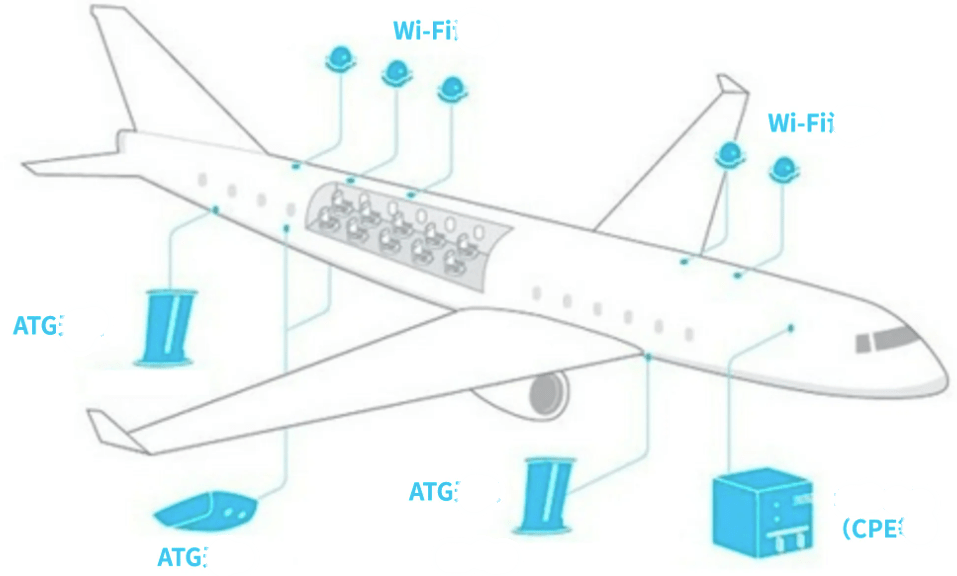
The aircraft side requires several modifications.
Unlike satellite communication systems, where antennas are usually installed on the upper surface of aircraft to communicate with satellites above, ATG antennas are typically installed on the lower part of the aircraft because the signal needs to communicate with ground stations.
The aircraft system generally includes:
- specialised ATG antennas;
- communication equipment;
- Customer Premises Equipment (CPE);
- onboard network equipment;
- passenger Wi-Fi systems.
The connection flow is:
ATG antenna → onboard communication equipment → cabin Wi-Fi network → passenger devices
For cockpit applications, the system can connect directly to dedicated aviation networks.
Although the architecture looks relatively simple, making it work reliably at aircraft speeds and altitudes is a major engineering challenge.
The Technical Challenges Behind Making ATG Work
Although the overall architecture of ATG appears straightforward, delivering reliable connectivity to aircraft travelling at hundreds of kilometres per hour is extremely challenging.

A commercial aircraft typically cruises at approximately 10,000 metres altitude and travels at around 800 km/h, with some aircraft capable of exceeding 1,200 km/h.
At this speed and distance, maintaining a stable wireless connection requires solving several difficult engineering problems.
1. Managing Doppler Frequency Shift
One of the biggest technical challenges is the Doppler effect.
When a device moves rapidly relative to a transmitter, the received radio frequency changes.
This phenomenon is familiar from everyday experiences, such as hearing a change in the pitch of an approaching ambulance siren.
In wireless communication, Doppler shift can cause problems because the receiving device may no longer interpret the transmitted signal correctly.
For aircraft travelling at high speeds, the relative movement between the aircraft and ground station can introduce significant frequency offsets.
To overcome this, ATG systems require advanced:
- algorithm optimisation;
- frequency compensation techniques;
- wireless parameter adjustments.
Modern 5G standards have introduced improvements to support high-mobility communication scenarios.
The development of these capabilities is part of the ongoing evolution of 5G networks defined by 3GPP.
2. Achieving Large Coverage Areas
A normal mobile base station is designed to serve users close to the ground.
ATG base stations face a different challenge.
Aircraft move quickly through the sky, meaning they would frequently switch between cells if coverage areas were too small.
Frequent handovers could negatively affect passenger experience by causing:
- connection interruptions;
- reduced speeds;
- unstable video streaming.
Therefore, ATG base stations require much larger coverage areas compared with traditional cellular networks.
By using specialised antenna designs, optimised frame structures, and advanced wireless parameters, modern 5G-ATG systems can significantly extend coverage.
Some reported deployments have achieved cell coverage extending hundreds of kilometres and supporting aircraft at high altitudes.
3. Prioritising Critical Aviation Data
An aircraft network does not only carry passenger entertainment traffic.
Different types of data have different importance levels.
For example:
- passenger video streaming;
- social media browsing;
- cloud applications;
are useful but not safety-critical.
However:
- aircraft monitoring data;
- operational information;
- flight-related communication;
require much higher reliability.
ATG systems therefore need advanced Quality of Service (QoS) management.
Different traffic types must receive different priorities to ensure important aviation services continue operating even when network demand increases.
This is similar to how modern telecom networks separate emergency services or business-critical applications from ordinary consumer traffic.
4. Advanced Antenna Technology
The antenna system is one of the most important parts of ATG technology.
Because aircraft are constantly moving, the communication system must continuously maintain a connection with ground stations.
Traditional antennas may struggle with this because signals can change rapidly as the aircraft moves.
To solve this problem, ATG systems can use technologies such as:
- phased array antennas;
- beamforming;
- beam tracking;
- Massive MIMO.
 These technologies allow the system to electronically adjust signal direction, improving transmission efficiency while reducing interference.
Some 5G-ATG systems use customised Massive MIMO antenna configurations, such as 64T64R systems, which provide stronger beamforming capabilities.
This allows the network to maintain stable connections with aircraft even during high-speed movement.
Aviation Safety: The Biggest Barrier to Commercial Deployment
The technology itself is only one part of the challenge.
Aviation is one of the most safety-critical industries in the world.
Unlike installing a home internet router or upgrading a mobile phone network, modifying aircraft communication systems involves strict testing, certification, and approval processes.
Every change made to an aircraft must demonstrate that it does not affect:
- flight safety;
- aircraft systems;
- electromagnetic compatibility;
- operational reliability.
Aircraft modifications must be performed through approved processes and receive airworthiness certification from relevant aviation authorities.
Organisations such as the Federal Aviation Administration (FAA) and European Union Aviation Safety Agency (EASA) oversee strict requirements for aircraft modifications and safety approvals.
This means ATG adoption cannot happen overnight.
Even if the communication technology is mature, airlines must complete extensive testing before commercial deployment.
Ground Deployment Challenges
Compared with aircraft modifications, upgrading ground infrastructure is relatively easier.
However, operators still need to address several challenges, including:
- spectrum allocation;
- interference management;
- network planning;
- flight route coverage;
- coordination between aviation and telecom industries.
Unlike ordinary mobile networks, ATG networks must consider aircraft movement patterns.
The network must be designed around flight corridors rather than population density.
What Is the Commercial Progress of ATG Around the World?
ATG is not a completely new idea.
The aviation industry has experimented with air-to-ground connectivity for many years.
Different regions have taken different approaches depending on spectrum availability, regulation, and market demand.
United States: Early ATG Adoption
The United States was one of the earliest markets to commercialise ATG.
In 2007, Aircell (later known as Gogo) acquired air-to-ground spectrum in the United States and launched one of the world’s first commercial ATG systems using 3G CDMA EV-DO technology.
The company later continued upgrading its technology from:
- 3G ATG;
- 4G ATG;
- next-generation systems.
Business aviation connectivity providers such as Gogo Business Aviation continue developing airborne connectivity solutions, particularly for business aircraft.
The US experience demonstrated that ATG could work commercially, although early systems had limitations compared with today’s 5G technology.
Europe: A Hybrid Satellite and ATG Approach
Europe explored a different model.
Because Europe has many densely populated regions but also extensive international flight routes, a combination of technologies was considered.
One example was the European Aviation Network (EAN), which combined:
- satellite communication;
- ground-based ATG infrastructure.
The system was developed with support from companies including Inmarsat.
This hybrid approach demonstrated that ATG could complement satellite networks rather than necessarily replace them.
China and the Development of 5G-ATG
China has also invested heavily in the development of 5G-based ATG technology.
Unlike earlier generations of ATG, which relied on older cellular technologies, the current focus is on integrating ATG with modern 5G networks.
A number of telecom operators, aircraft manufacturers, airlines, and equipment suppliers have conducted testing and trials to evaluate:
- network performance;
- aircraft connectivity;
- handover reliability;
- commercial feasibility.
A key milestone was the approval of dedicated spectrum resources for 5G-ATG trials, allowing operators to test dedicated air-to-ground communication networks.
The development of 5G-ATG is also linked to the evolution of global 5G standards, particularly later 3GPP releases that introduced features supporting high-speed and non-terrestrial communication scenarios.
The Future of 5G-ATG
The recent increase in industry cooperation suggests that ATG has moved beyond being only a research concept.
However, commercial success will depend on several factors:
- aviation certification;
- network reliability;
- aircraft installation costs;
- passenger demand;
- cooperation between telecom operators and airlines.
The most likely future is not a complete replacement of satellite connectivity.
Instead, aviation connectivity will probably become a hybrid ecosystem:
- ATG for high-speed, low-latency connectivity over land;
- satellite networks for global coverage and remote routes.
Final Thoughts: Can ATG Really Succeed?
For passengers, the promise of ATG is simple:
A future where being on a plane no longer means disconnecting from the digital world.
Instead of waiting until landing to reply to messages, watch videos, attend meetings, or access online services, passengers could enjoy a connected experience throughout their journey.
For airlines, ATG could provide more than passenger entertainment.
It could enable smarter aircraft operations, improved maintenance, better communication between aircraft and ground teams, and a foundation for future digital aviation services.
The technology still faces significant challenges, particularly around safety certification, global coverage, and commercial deployment.
However, with continued advances in 5G networks, antenna technology, and aviation connectivity standards, 5G-ATG air-to-ground communication could become an important part of the future aviation ecosystem.
The goal is no longer simply connecting passengers to the internet.
It is creating a fully connected aircraft that operates as intelligently in the sky as modern vehicles and devices do on the ground.
Leave a Reply